



Labeling “Honest Sign”: application

How to correctly apply “Honest Sign” codes: rules, formats, and recommendations for marketplace sellers
Leave your contact details, and our manager will contact you within one hour.
All customs clearance details are handled by us


Advantages of working with TTL
TTL provides comprehensive product labeling services. Experts guarantee compliance with legislative regulations and protection from sanctions imposed by regulatory authorities. High-tech equipment and well-established technologies ensure accuracy and reliability of every labeling operation.
Partnership with TTL eliminates errors in documentation flow and product coding. A qualified team oversees the full cycle from application processing to the issuance of ready product identifiers.
Application of “Honest Sign”
The labeling process begins with selecting an appropriate method for printing codes. Manufacturers analyze packaging material, product storage conditions, and durability requirements for the labeling. Each method has its own application specifics and technical limitations.
Thermal transfer printing creates durable codes on labels made from various materials. A ribbon with an ink layer transfers the image to the substrate under heat. This method is suitable for products with a long shelf life.
Inkjet technology allows codes to be applied directly onto packaging without additional materials. The ink penetrates the surface and creates a high-contrast image. This method is cost-effective for large production volumes.
Laser engraving provides maximum protection of labeling against external influences. The beam creates indentations in the material, forming a readable code. Such labeling does not wear off or peel over time. It is important to note that Honest Sign for marketplaces must meet strict readability standards.
Features of “Honest Sign” labeling and why it is required
The digital labeling system creates a transparent supply chain from manufacturer to consumer. Each product receives a unique identifier containing encrypted information about its origin. Data is automatically transmitted to the state information system each time ownership changes.
Retail stores use labeling to automate inventory accounting and prevent theft. Scanning codes upon receipt creates an electronic inventory database. Selling a labeled product without recording it in the system becomes impossible.
Consumers receive a tool to verify the authenticity of purchased goods. The “Honest Sign” mobile application shows the full history of product movement. According to Rosstat studies, the share of counterfeit goods in labeled product categories decreased by 67% over two years of the system’s operation.
Government control over product circulation is strengthened through the digital trace of each unit of goods. Tax authorities receive reliable data on production and sales volumes. This helps prevent tax evasion schemes.
Technical requirements for code placement
Correct positioning of labeling on packaging affects the speed and accuracy of information scanning. The code must be placed on a flat surface without bends or deformations. The distance from the edges of the packaging must be at least 3 millimeters to prevent damage.
Manufacturers must consider several critical factors when choosing the placement location. Labeling must not be covered by other design elements or additional labels. Codes should be placed in an area accessible for scanning without opening the original packaging. The surface under the label must be clean and dry to ensure reliable adhesion.
Key placement requirements include:
- Contrast of at least 80% between the background and code elements.
- No glare or reflections on the labeling surface.
- Protection from mechanical damage during transportation.
- Compliance with code size standards established for the product group.
Violation of placement requirements leads to scanning issues for consumers and retail equipment. Poorly readable codes slow down checkout operations and create queues in stores. Regulatory authorities may deem such labeling invalid and impose fines on the manufacturer. Honest Sign sales through marketplaces are especially demanding in terms of code placement quality.
Automation of labeling processes
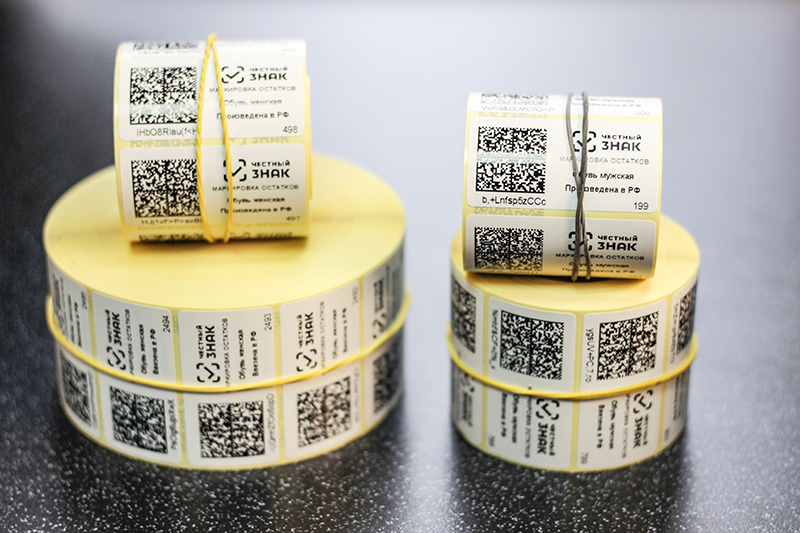
Modern packaging lines are integrated with labeling application systems to increase productivity. Automatic printer-applicators apply codes without stopping the conveyor. Labeling speed reaches up to 600 product units per minute while maintaining high print quality.
Software controls the accuracy of data in each code before it is applied to the packaging. The system verifies that product information matches specified parameters and rejects incorrect codes. Built-in scanners assess print quality and discard unreadable labels.
Centralized management allows coordination of multiple packaging lines from a single control center. Operators can view statistics for each line and respond quickly to malfunctions. Automated reports contain data on the number of applied codes and the defect rate.
Backup systems ensure production continuity in case primary equipment fails. Redundancy of critical components prevents conveyor downtime. Rapid switching between printers occurs automatically without operator involvement. It is important to note that Honest Sign trade on marketplaces requires special attention to the stability of labeling processes.
Quality control and system monitoring
A multi-stage control system ensures high labeling quality at all stages of production. Incoming inspection checks the quality of consumables and correct equipment setup. Operational control monitors printing parameters in real time.
Automated monitoring systems analyze each applied code and compare it with reference samples. Deviations from the norm are recorded in the event log with indication of time and cause. The operator receives notifications about the need to adjust equipment parameters.
Specialized high-resolution cameras check the geometric parameters of codes and their readability. The software analyzes contrast, edge clarity, and the absence of printing defects. Statistical data help identify trends of quality degradation before critical issues occur.
Regular calibration of measuring equipment maintains the accuracy of quality control. Reference samples are used to verify the operation of scanners and inspection cameras. Calibration protocols are maintained in accordance with quality standard requirements. Periodic maintenance includes several mandatory procedures:
- Cleaning optical elements of the inspection system.
- Checking camera positioning accuracy.
- Updating image analysis software.
- Replacing worn mechanical components.
- Testing emergency stop systems.
Documentation of all quality control procedures creates a basis for process analysis and improvement. Reports contain statistics on defect types and their frequency. Data analysis helps optimize equipment settings and reduce the defect rate. Honest Sign labeling for marketplaces imposes increased requirements on documenting control processes.
TTL provides comprehensive implementation of the labeling system with a guaranteed result. A professional team resolves all technical issues and ensures uninterrupted equipment operation.

















Contacts
Leave your contact details, and our manager will contact you within one hour.